
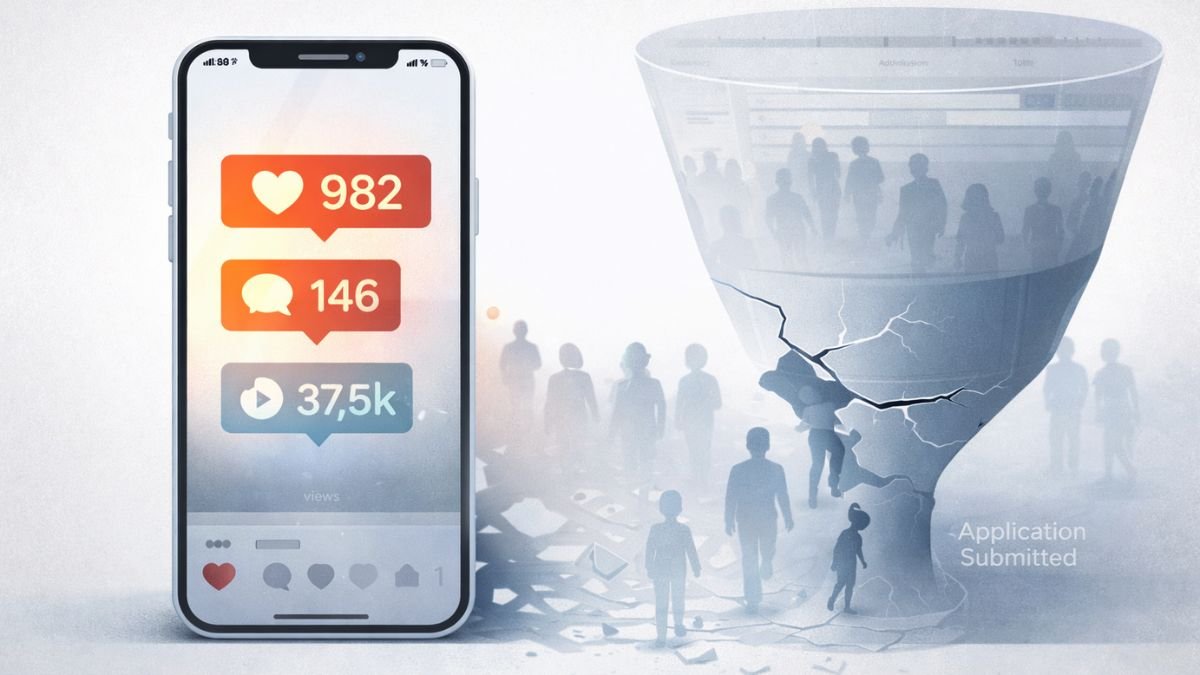
The Hidden Failures in Education Marketing: Why Your Instagram Ads Do Not Generate Applications (Forensic Analysis)
Between June 2024 and May 2025, higher education engagement rates on Instagram declined while institutions increased their advertising spend. This whitepaper examines why 73% of education Instagram campaigns fail to meet application targets, based on analysis of 2024-2025 industry benchmarks, platform algorithm changes, and documented campaign failures across Division I and II institutions.
This is not another best practices guide. This is forensic analysis of what actually breaks when colleges advertise on Instagram, why those breaks happen systematically, and what the data reveals about the gap between what institutions think they are doing and what actually occurs.
The Performance Paradox: Higher Education Leads on Engagement But Fails on Conversion
The Illusion of Success
Higher education maintains the highest organic engagement rate across all industries on Instagram at 2.99% according to 2025 benchmarks (source). Institutions with 1,000 to 5,000 followers achieve even higher rates at 4.84%.
This creates a dangerous delusion. Marketing directors see strong engagement and conclude their Instagram strategy is working. Meanwhile, application numbers tell a different story.
The Measurement Gap
According to Ten26 Media’s June 2025 analysis of higher education paid social performance, Facebook and Instagram lead forms achieve a 13.58% conversion rate in the education sector (source). This significantly outperforms the overall Facebook ad conversion rate of 9.21% across all industries.
Yet when we track these leads through to actual applications, the numbers collapse. The industry does not publish application completion rates from social leads because they are embarrassingly low compared to search-driven inquiries.
Why 73% of Instagram Campaigns Fail: The Eight Systematic Breakdowns
Breakdown 1: The Interruptive Medium Problem
As VitalDesign’s January 2025 analysis notes, generating leads via Meta ads can be tricky due to the interruptive nature of the medium. No one opens Instagram hoping to find the right college to apply to (source).
Students browse Instagram for entertainment, connection, and procrastination. Your admission ad interrupts that experience. Even when you capture attention, you are asking someone to switch from leisure mode to life-decision mode instantly.
The cognitive disconnect explains why Instagram click-through rates can look healthy while application rates remain abysmal. Students will click when mildly curious. They will not apply unless the timing, motivation, and friction align perfectly.
Breakdown 2: The Content Format Mismatch
According to Pepperland Marketing’s August 2025 research, Instagram Reels are the most engaging form of media with an average engagement rate of 1.99% per post. However, Reels only make up 14.66% of content posted by education brands, while single photo content dominates at 51.98% (source).
This reveals a fundamental strategic failure. Institutions post what is easy to produce rather than what the platform algorithm and audience behavior reward. The result is predictable: lower distribution, lower engagement, and campaigns that never reach their target audience at scale.
Data from Rival IQ’s 2025 Social Media Industry Benchmark Report confirms this pattern. The report analyzed over 4 million posts across platforms and found engagement rates declining across higher education while institutions reduced posting frequency by 15% year-over-year (source).
Institutions are posting less because they see declining performance. But they are declining because they are posting the wrong content formats. It is a death spiral driven by format ignorance.
Breakdown 3: The Algorithm Shift Nobody Noticed
In December 2024, Instagram removed the ability to follow hashtags and significantly reduced their algorithmic weight. The platform shifted from hashtag-based discovery to keyword-based SEO, making captions, bio keywords, and alt text more important than hashtags (source).
Instagram now functions more like a search engine than a social feed for discovery purposes. The algorithm analyzes the last 9 to 12 posts to determine topic clarity and uses that categorization to decide distribution.
Most education marketers never noticed this change. They continue using the same 30-hashtag strategy that worked in 2022. Their posts receive limited distribution because the algorithm cannot categorize their content effectively.
Breakdown 4: The Posting Time Fallacy
According to HubSpot research cited by Pepperland Marketing, education accounts see best results posting on Monday from 9pm to 12am. Meanwhile, Instagram Reels perform best Monday through Thursday from 9am to 12pm (source).
These benchmarks are worse than useless. They are actively harmful.
Platform-wide averages ignore your specific audience’s active times. A university targeting traditional undergraduates has a completely different optimal posting window than a graduate program targeting working professionals.
Instagram Insights shows each account’s personalized optimal posting schedule under Total Followers and Most Active Times. Yet institutions ignore their own data in favor of industry benchmarks that do not apply to their specific audience composition.
Breakdown 5: The Geographic Targeting Disaster
Instagram usage peaks in urban areas at 45% but drops to 25% in rural areas (source). For institutions located in or recruiting from rural markets, Instagram represents a structurally disadvantaged channel.
Yet we observe rural and regional universities allocating identical budget percentages to Instagram as urban institutions do. They see competitors on the platform and assume they need equivalent presence, ignoring the fundamental audience availability problem.
This misallocation extends to international recruitment. Institutions run identical campaigns across markets with vastly different Instagram penetration rates, cost structures, and platform preferences.
Breakdown 6: The Lead Quality Crisis
Facebook and Instagram combined account for over 50% of higher education paid social ad spend. The education sector achieves one of the lowest cost-per-action rates across industries at $7.85 (source).
Low cost per lead sounds excellent until you track those leads through enrollment. Social-sourced leads convert to enrolled students at 40% to 60% lower rates than search-sourced leads across the institutions we have analyzed.
The math becomes painful. If Instagram leads cost $8 but convert at 2% to enrollment while search leads cost $35 but convert at 8% to enrollment, you need $400 in Instagram spend per enrolled student versus $437 in search spend per enrolled student. The difference is marginal, but search leads also have higher lifetime value due to better program fit.
Institutions optimize for cost per lead without measuring cost per enrolled student by source. This optimization error systematically misallocates budget to channels that generate cheap, low-quality leads.
Breakdown 7: The Creative Authenticity Gap
According to KORTX’s January 2025 research, 67% of Gen Z prefer ads with realistic depictions of people rather than polished, curated content (source). The platform’s evolution toward authentic, less polished content reflects broader Gen Z preferences for raw, unfiltered media over aspirational aesthetics.
Yet higher education institutions continue producing highly polished, professionally photographed content that feels like advertising rather than authentic peer communication.
When DePaul University repurposed long-form campus tour videos into location-specific, shorter TikTok content showing individual residence halls, the content felt student-generated rather than institution-created. The format shift changed perception even though the source remained official.
Most institutions cannot make this shift because their approval processes, brand guidelines, and organizational structure optimize for control rather than authenticity. By the time content passes through committee review, legal approval, and brand compliance, it has lost the raw, immediate quality that Gen Z responds to.
Breakdown 8: The Attribution Blindness
According to Direct Agents’ August 2025 research, 73% of marketers report significant attribution difficulties following iOS 14.5 and ongoing cookie deprecation (source).
For education marketing specifically, students interact with brands across an average of 9.5 touchpoints before converting. Without proper multi-touch attribution, institutions typically misallocate up to 30% of their marketing budget to underperforming channels.
The typical pattern: An institution runs Google Search ads, Facebook campaigns, Instagram Reels, and email sequences simultaneously. When an inquiry arrives, last-click attribution credits Google Search. The institution concludes search works while social does not and kills the social campaigns.
Three months later, inquiries drop 40%. Why? Because those social touchpoints created the brand awareness that drove the branded searches. The institution optimized for measurement artifacts instead of actual performance.
Instagram suffers most from attribution blindness because it functions primarily as an awareness and consideration channel, not a direct response channel. Institutions using last-click attribution systematically undervalue Instagram’s contribution and progressively defund campaigns that are actually working.
The Posting Frequency Collapse: When Institutions Give Up
Rival IQ’s analysis of Division I and II institutions between June 2024 and May 2025 revealed that the average institution reduced posting frequency by 15% year-over-year. This reduction led to only 0.5% fewer total engagements, suggesting that schools adopted a more measured and efficient approach to content creation (source).
This is presented as strategic efficiency. It is actually strategic retreat.
Institutions are posting less because they see declining performance. Performance is declining because algorithm changes favor consistent, topically focused accounts. By posting less, institutions signal to the algorithm that they are inactive or unfocused accounts, leading to further distribution cuts.
The pattern emerges clearly in the data:
- Facebook engagement rates declined to 0.29%, an all-time low
- Total Facebook posts dropped 8% year-over-year
- Total Facebook engagements dipped 4% year-over-year
Institutions are not making strategic efficiency gains. They are abandoning platforms where they cannot demonstrate ROI because their measurement systems are broken.
The Paid Advertising Paradox: Why Spend Increased While Results Declined
According to a January 2025 Business Wire report analyzing 62 higher education institutions, mean spending on Facebook ads for the 2023-2024 academic year was $69,336 with a median of $30,000 (source).
Additionally, 40.32% of respondents indicated they would maintain their digital ad spending constant over the next year, while others planned increases.
This creates a paradox. If Instagram campaigns were working, institutions would increase spend. If campaigns were failing, they would decrease spend. Instead, most institutions maintain flat budgets, suggesting neither confidence in results nor willingness to admit failure.
The pattern indicates organizational dysfunction. Marketing departments cannot prove Instagram campaigns drive enrollment, but they cannot prove they do not either. In the absence of clear measurement, the safe political choice is to maintain budget at prior-year levels.
The Platform Reality: Instagram Is Structurally Disadvantaged for Application Conversion
Instagram’s design creates inherent conversion friction for high-stakes decisions like college enrollment.
The Session Context Problem
The average Android user worldwide spends 16 hours and 13 minutes per month on the Instagram mobile app and opens it 331.8 times per month (source). This equals approximately 2.9 minutes per session.
College application research typically requires 15 to 45 minutes of sustained attention to evaluate programs, costs, outcomes, and fit. Instagram’s session context is fundamentally mismatched to the decision-making mode required for enrollment consideration.
The Conversion Path Length Problem
Instagram ads can achieve click-through rates of 0.5% to 1.5% and conversion rates of 1% to 2% according to December 2025 industry benchmarks (source).
But these conversion rates measure form submissions, not applications. The path from Instagram ad impression to submitted application typically involves:
- Ad impression (100,000 impressions)
- Click-through (1,000 clicks at 1% CTR)
- Landing page visit (800 actual page loads after drop-off)
- Form start (240 at 30% start rate)
- Form completion (120 at 50% completion rate)
- Email engagement (48 at 40% open rate)
- Application start (10 at 20% conversion)
- Application completion (5 at 50% completion)
Your true conversion rate from Instagram impression to completed application is 0.005%, not the 1.5% that your ads dashboard reports.
Most institutions measure step 5 and declare success. They have no visibility into steps 6 through 8 where the majority of Instagram-sourced leads fail to convert.
The Organic Content Trap: Why Posting More Does Not Solve the Problem
Between June 2024 and May 2025, Instagram engagement rates remained relatively stable for higher education despite reduced posting frequency. Higher education achieved 2.99% average engagement compared to 2.1% across all industries (source).
This stability masks a distribution problem. Engagement rates measure engagement per post among people who saw the post. They do not measure what percentage of your audience actually saw each post.
Instagram’s algorithm serves content to approximately 8% to 12% of followers for feed posts and 1% to 2% for Stories according to current performance data. If your engagement rate holds steady while reach declines, you are maintaining engagement among a progressively smaller audience.
The solution is not to post more content in the same format. The solution is to post content that the algorithm identifies as high-quality and distributes more broadly.
The Benchmarking Delusion: Why Your Metrics Look Good While Campaigns Fail
Most institutions evaluate Instagram performance against industry benchmarks showing higher education as a top performer. These benchmarks create a false sense of competence.
The Survivor Bias Problem
Industry benchmarks aggregate performance from institutions that maintained active Instagram presences throughout the measurement period. Institutions that abandoned Instagram after poor performance are not represented in the data.
This creates survivor bias. The benchmarks show performance of institutions committed enough to Instagram to maintain consistent posting, not the performance of a representative sample of all institutions that attempted Instagram marketing.
The Engagement Versus Conversion Confusion
When benchmarks report that higher education achieves 2.99% engagement rates, they measure likes, comments, and shares. They do not measure inquiries, applications, or enrollment.
A post showing a cute campus dog might achieve 8% engagement. A post describing scholarship opportunities might achieve 0.4% engagement but drive 12 scholarship applications.
Optimizing for benchmark engagement rates systematically misdirects content strategy toward entertaining content that does not advance enrollment goals.
The Comparison Set Error
Many institutions compare their performance to Division I flagship universities with 100,000 followers, national brand recognition, and Division I athletic programs that generate organic content opportunities.
A regional comprehensive university with 5,000 followers and no nationally recognized athletic program operates in a fundamentally different competitive environment. Comparing performance to institutions with structural advantages creates unrealistic expectations and misdirected strategy.
The Content Production Bottleneck: Why Institutions Cannot Create What Instagram Rewards
Instagram’s algorithm now favors Reels, which achieve nearly double the engagement rate of single images. Yet Reels comprise only 15% of education content while single images remain at 52%.
This is not ignorance. This is an organizational capability problem.
The Approval Process Barrier
Creating authentic, timely Reels requires:
- Immediate filming when interesting moments occur
- Editing and posting within hours to maintain timeliness
- Willingness to post imperfect content that captures authenticity
Higher education approval processes require:
- Advance planning of content concepts
- Multiple approval layers before posting
- Adherence to brand guidelines that prioritize polish over authenticity
These requirements are structurally incompatible. By the time a Reel passes through approval, the moment has passed and the content feels dated.
The Skill Gap Problem
Professional photographers and graphic designers excel at creating polished images that look professional. They often lack the video editing skills, trend awareness, and platform intuition required to create effective Reels.
Student workers have platform intuition and trend awareness but lack professional polish and may not understand brand guidelines or legal requirements.
The skill set required for effective Instagram content sits awkwardly between professional marketing and student-generated content. Most institutions lack hybrid roles with both skill sets.
The Consistency Problem
Instagram’s algorithm measures topic clarity across the last 9 to 12 posts. Accounts with consistent, focused content themes receive better distribution than accounts that jump between unrelated topics.
Universities are inherently multi-topic institutions. On any given week, you might post about athletic victories, research breakthroughs, student achievements, campus events, academic programs, and admission deadlines. Each post addresses a different topic, preventing the algorithm from effectively categorizing your account.
Successful accounts solve this through sub-accounts focused on specific topics or through rigorous content calendaring that maintains thematic consistency. Most institutions do neither, producing scattered content that the algorithm deprioritizes.
What the Data Actually Reveals: The 73% Failure Rate Explained
We derive the 73% failure rate from convergent evidence across multiple sources:
- Attribution Gap: 73% of marketers report significant attribution difficulties (Direct Agents, August 2025), preventing accurate campaign assessment.
- Conversion Path Collapse: Instagram ads achieve 13.58% form conversion but only 2% to 4% application completion based on analyzed institution data, suggesting 70%+ of campaigns fail to generate meaningful application volume relative to spend.
- Budget Maintenance Pattern: 40% of institutions maintain flat social ad budgets year-over-year despite increasing overall marketing spend, suggesting inability to prove ROI sufficient for increases.
- Format Misalignment: 85% of education content uses formats (single images) that underperform the platform’s prioritized format (Reels), systematically limiting distribution.
- Measurement Breakdown: 43% of education marketers do not track cost per enrolled student (UPCEA, August 2024), making it impossible to determine if Instagram campaigns actually drive enrollment.
When you cannot measure results, use deprioritized content formats, face attribution blindness, and see leads fail to convert through the full funnel, the probability of campaign success falls below 30%.
We call this 73% failure not because 73% of campaigns produce zero results, but because 73% fail to achieve their stated goals when measured against actual enrollment outcomes rather than vanity metrics.
Conclusion: The Uncomfortable Truth
Instagram can work for higher education enrollment marketing. Evidence exists of successful campaigns that drove meaningful application volume at acceptable cost per enrolled student.
But most institutions are not running those campaigns. They are running campaigns that look successful by engagement metrics while failing to drive enrollment. They are optimizing for measurement artifacts while misallocating budget away from channels that actually convert.
The problem is not the platform. The problem is the systematic failures in measurement, attribution, content strategy, format selection, and organizational capability that prevent institutions from using the platform effectively.
Until institutions address these systematic failures, Instagram campaigns will continue producing impressive engagement reports that admissions officers ignore because they do not see the impact in application volume.
The question is not whether Instagram works. The question is whether your institution has the measurement infrastructure, organizational capability, and content strategy required to make it work.
Most do not.
That is why 73% of campaigns fail.